
Preserving Nuestra Historia

Preserving Nuestra Historia ("Preserving Our History") is a collaborative effort to preserve Michigan's Latino history for communities, researchers, and future generations. We seek to do so by: 1) creating open access to digital collections of scanned photographs and documents and oral histories of Latino history, 2) teaching communities how to preserve their photographs, documents, and material culture for future generations;and 3) helping improve the relationsihp between Latino communities and local public history institutions. Collaborators on the project include representatives from the Michigan History Center (MHC), Archives of Michigan, Latino Leaders for Equity Advocacy and Development (LLEAD), Chicano/Latino Studies at Michigan State University, the Fraga Family History Project, and the Julian Samora Research Institute (JSRI).
This project emerged from Addressing the Silences, an iniatitive of the International Coalition of Sites of Conscience (ICSC) that "aims to help sites create ever deeper, more meaningful relationships in their communities-relationships that foster co-creation and correct silences and absences in their institutions so that they can better leverage their extraordinary capacity to serve as spaces for reflection and centers for positive social change." ICSC, with funding from the Institute of Museum and Library Services, selected Michigan History Center as one of the 10 partner sites for the project, which ran from fall 2022 to summer 2025.
As part of MHC’s efforts to identify gaps in its historical interpretation and better engage community partners, MHC partnered with Dr.
Delia Fernández-Jones, associate dean for equity, justice, and faculty affairs in the College of Arts & Letters and core faculty member of the Chicano/Latino Studies program at Michigan State University.
Dr. Fernández-Jones guided internal changes at MHC and connected the organization with Latino communities in Michigan.
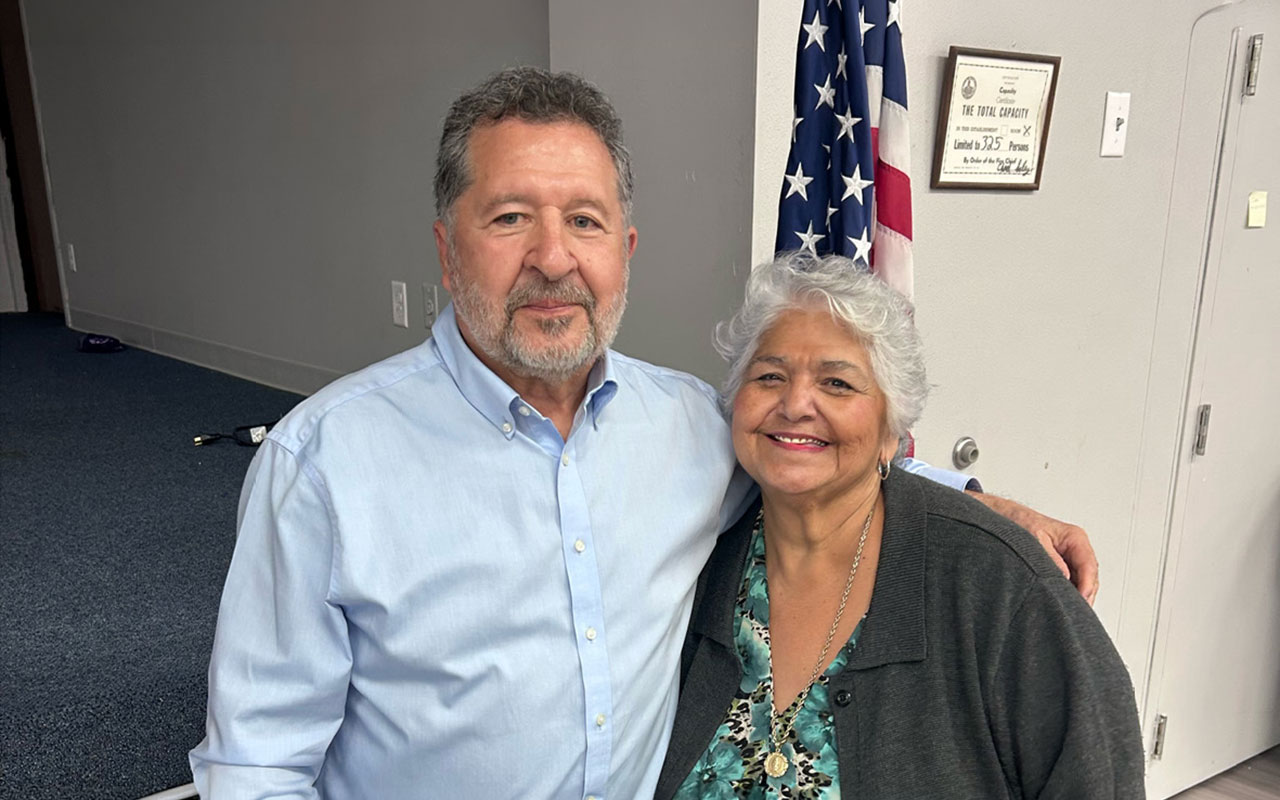
Al Flores and Christina Estrada participated in oral history interviews as part of an effort to document the history of Latino communities for future generations.
In partnership with LLEAD, MHC and Dr. Fernández-Jones launched a pilot project to document and share Latino history and culture in Michigan. Three cities were selected: Adrian, Fennville, and Bay City, because they are representative of the various degrees of preparation and familiarity with historical preservation, length of time in the area, and relationships with historical institutions. For example, the Latino community in Adrian, Michigan, has a 100-year history in the area and has begun to develop relationships with local historical institutions. They also have a long history of doing their own historical preservation within the community. Bay City Latinos also have a long history in the area and a tradition of preserving and celebrating their local Latino history. However, they do not have relationships with historical institutions to preserve this history in a sustainable way. Lastly, Fennville, Michigan, has a newer, growing population of Latinos, but the community has not had an opportunity to document or record their history in a systematic way and has no relationships with local historical institutions. Initial meetings were held with each community to introduce preservation skills—caring for documents/photos, conducting oral histories—and archival starter kits were provided. Community members were not asked to donate materials at the time.
We have entered the second phase of the project, in which we seek to create digital collections and hold additional preservation workshops in Bay City, Adrian, and Fennville. To do this, we will host community
meetings that show people how to do oral histories, while also recording oral histories with community members, doing workshops on how to preserve their materials in their homes, and scanning materials for their personal use or to share. Through our recordings and scanned items, we will create stand-alone digital archival collections with
the help of local historical institutions. Each city will also be asked to identify an initial topic area for collection. We will also work with each community to create a public history programming aspect
of their choosing so we can share these histories. For example, the Bay City community wants to create banners to hang in their local downtown area to tell the history of Latino veterans, with a link to listen to oral history interviews about them. Finally, we will create a toolkit so that this work may be replicated in other communities.
We formally kicked off Phase 2 in Bay City on November 15, roughly coinciding with Veterans Day, where we invited Latino veterans and/ or their families to a luncheon to acquaint them with the project. We also demonstrated the oral history process through live oral history interviews with Christina Estrada, sister of Jesse Carmona, Jr., a casualty of the Vietnam War, and Alberto Flores, president of LLEAD and brother of Fred and Frank Flores, both veterans of the Vietnam War, conducted by Dr. Richard Cruz Dávila of the Julian Samora Research Institute. We will follow up this event with collection days on April 18 and May 30 in Bay City, where we will scan photos and documents and conduct oral history interviews. Materials collected will guide the creation of the banners to be displayed in downtown Bay City. Similar events will follow in Adrian and Fennville.
By developing open access digital collections and a toolkit for communities who wish to replicate this process, we will create ways for community members, researchers, and public history professionals to learn about the history of Latinos in Michigan and establish pathways for sustainable preservation of these histories. In teaching community members how to collect oral histories and preserve their own photos and documents, we can also ensure that the project continues into the future and that histories are passed down through generations.
Though this population has been in Michigan for over 100 years, they are often left out of mainstream narratives of Michigan history, and thus members of this group often feel overlooked and are under- researched. Preserving Nuestra Historia represents one of the
first coordinated efforts to engage Latino communities across the state for the purpose of historical preservation. With public-facing programming as a part of this project, researchers and community members will see a side of Michigan history that is often forgotten.