
Occupation and Industry of Employment by Race/Ethnicity and Gender in Michigan, 2020-2024

INTRODUCTION
Understanding how employment is distributed across occupations and industries is essential for examining labor market patterns and demographic representation. In Michigan, data from the 2020–2024 Current Population Survey Annual Social and Economic Supplement (CPS ASEC) provide detailed insights into how employment varies by race/ethnicity and gender.
This study focuses on civilian individuals aged 16 and older who are employed in Michigan, with special attention to Latino workers and other racial and ethnic groups. It examines patterns in major and detailed occupational categories, highlighting which groups are concentrated in management, service, production, and other types of work.
The study also explores industry-level employment, capturing how race/ethnicity and gender intersect within sectors such as manufacturing, health care, retail, and agriculture.
This descriptive analysis uses weighted estimates to reflect population- level patterns. The goal is to identify disparities in occupational and industry representation and to provide a comprehensive view of Michigan’s labor force. In doing so, the study highlights how gender and race/ethnicity shape employment outcomes.
DATA AND METHODS
Data were drawn from the 2020–2024 ASEC survey files of the March Current Population Survey (CPS), a monthly survey of about 54,000 households conducted by the U.S. Census Bureau. The CPS covers the noninstitutionalized civilian population aged 15 and older, and the March supplement includes detailed information on employment, income, and demographic characteristics such as age, sex, race, household relationship, and Hispanic origin.
For this study, the sample is restricted to civilian individuals aged 16 and older who are employed and reside in Michigan. All analyses apply the personal weight variable (A_FNLWGT) to account for the complex survey design. The unweighted sample includes 7,260 individuals, corresponding to a weighted estimate of approximately 4.5 million employed persons in Michigan.
The analysis is descriptive and examines how employment is distributed across detailed occupations and industries, with attention to differences by race/ethnicity, gender, and working hours. Cross-tabulations are used to compare employment patterns across groups. Specifically, the study includes:
-
Distribution of employment across major occupations.
-
Occupational breakdowns by race/ethnicity.
-
Intersection of race/ethnicity and gender in occupational distribution.
-
Distribution of industries of employment by race/ethnicity.
-
Industry distribution by both race/ethnicity and gender.
All results use weighted estimates, and tables and charts summarize patterns and disparities across demographic groups.
FINDINGS
OCCUPATION DISTRIBUTION IN MICHIGAN, 2020–2024
Michigan’s workforce during 2020–2024 included approximately 4.5 million employed individuals aged 16 and older. Table 1 shows the distribution of employment across occupational groups. Management, professional, and related occupations represented the largest share (11.5%), followed by office and administrative support (10.4%), production occupations (9.0%), and sales occupations (8.9%). Service occupations accounted for between 5.1% and 5.2% of employment, while farming, fishing, and forestry (0.5%) and construction and extraction (3.6%) represented the smallest shares.
Table 1. Occupation Distribution in Michigan, 2020–2024
|
Detailed occupation |
Total population |
Percentage of total population |
|---|---|---|
|
Management occupations |
522,472 |
11.5 |
|
Office and administrative support |
473,027 |
10.4 |
|
Production occupations |
409,340 |
9 |
|
Sales and related |
403,224 |
8.9 |
|
Health care practitioner and technical |
328,272 |
7.3 |
|
Transportation and material moving |
298,072 |
6.6 |
|
Business and financial operations |
269,300 |
5.9 |
|
Education, training, and library |
234,574 |
5.2 |
|
Food preparation and serving related |
232,170 |
5.1 |
|
Architecture and engineering |
184,630 |
4.1 |
|
Health care support |
177,662 |
3.9 |
|
Construction and extraction |
164,636 |
3.6 |
|
Computer and mathematical |
157,132 |
3.5 |
|
Installation, maintenance, and repair |
136,523 |
3 |
|
Building and grounds cleaning and maintenance |
109,446 |
2.4 |
|
Personal care and service occupations |
99,977 |
2.2 |
|
Arts, design, entertainment, sports, and media |
87,399 |
1.9 |
|
Community and social service |
77,875 |
1.7 |
|
Protective service |
49,981 |
1.1 |
|
Legal occupations |
44,252 |
1 |
|
Life, physical, and social science |
42,189 |
0.9 |
|
Farming, fishing, and forestry occupations |
24,645 |
0.5 |
Source: U.S. Census Bureau, Current Population Survey, 2020 -2024 Annual Social and Economic Supplement (CPS ASEC).
SELECTED OCCUPATION DISTRIBUTION IN MICHIGAN, 2020-2024
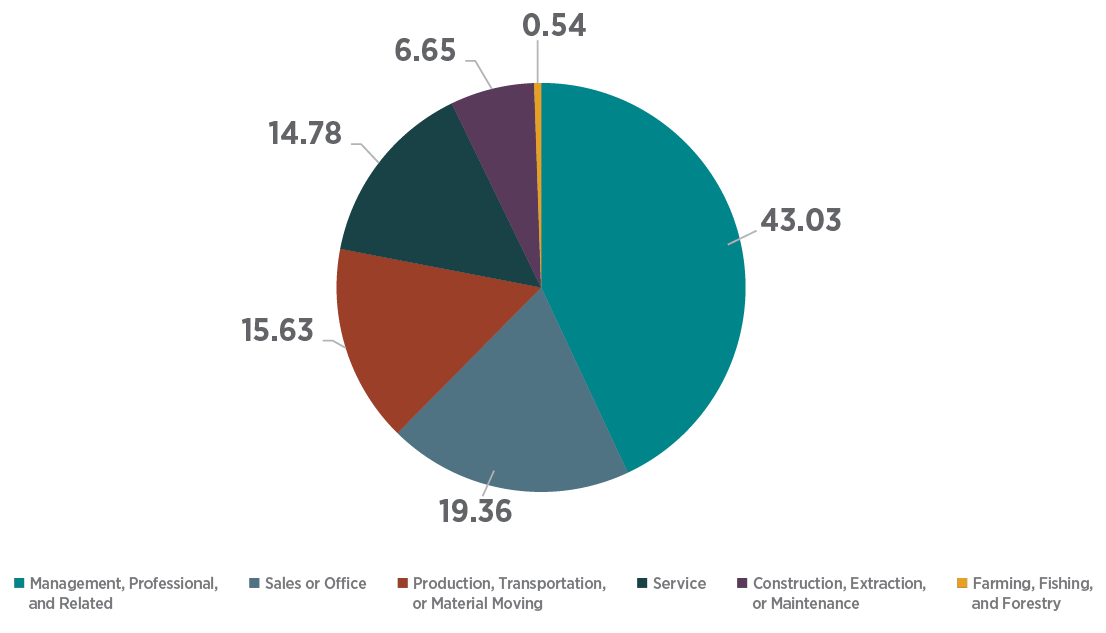
Table 2 and Figure 1 show that management, professional, and related occupations constitute the largest share of Michigan’s workforce (43%), followed by sales or office roles (19%) and production, transportation, or material moving (16%). Service occupations also represent a sizeable portion (15%). Farming, fishing, and forestry remain the smallest category at just 0.5% of total employment.
Table 2. Selected Occupations Distribution in Michigan, 2020–2024
|
Selected occupation |
Total population |
Percentage of |
|---|---|---|
|
Total |
4,526,798 |
100.00 |
|
Management, professional, and related |
1,948,095 |
43.03 |
|
Sales or office |
876,252 |
19.36 |
|
Production, transportation, or material moving |
707,414 |
15.63 |
|
Service |
669,233 |
14.78 |
|
Construction, extraction, or maintenance |
301,159 |
6.65 |
|
Farming, fishing, and forestry |
24,646 |
0.54 |
Source: U.S. Census Bureau, Current Population Survey, 2020 -2024 Annual Social and Economic Supplement (CPS ASEC).
Figure 1. Selected Occupation Distribution in Michigan, 2020–2024
Source: U.S. Census Bureau, Current Population Survey, 2020 -2024 Annual Social and Economic Supplement (CPS ASEC).
OCCUPATION BY RACE/ETHNICITY, 2020-2024
Management, professional, and related occupations are the most common among all racial/ethnic groups, especially Asians (59%) and whites (45%). Service occupations are more prevalent among African Americans (19%) and Latinos (18%) compared with whites (14%) and Asians (13%). Sales or office roles are most common among African Americans (23%) and whites (20%), while Latinos (14%)
and Asians (11%) are less represented. Production, transportation, and material-moving occupations constitute major employment sectors for Latinos (26%) and African Americans (25%).
Overall, these results point to distinct occupational patterns by race/ethnicity, with Latinos and African Americans more often in production and service roles and Asians more concentrated in management and professional fields.
Table 3. Selected Occupations by Race/Ethnicity in Michigan, 2020–2024
|
Selected occupation |
White only |
African American only |
Latino/ Hispanic |
Asian only |
|---|---|---|---|---|
|
Farming, fishing, and forestry |
0.5 |
0.3 |
2.2 |
0 |
|
Construction, extraction, or maintenance |
7.4 |
3.5 |
5.9 |
3.2 |
|
Service |
14.5 |
18.6 |
17.5 |
13.2 |
|
Sales or office |
19.7 |
22.8 |
13.9 |
11.1 |
|
Production, transportation, or material moving |
13.7 |
24.6 |
25.7 |
13.6 |
|
Management, professional, and related |
44.7 |
30.2 |
34.8 |
58.9 |
Source: U.S. Census Bureau, Current Population Survey, 2020 -2024 Annual Social and Economic Supplement (CPS ASEC).
OCCUPATION BY GENDER IN MICHIGAN, 2020-2024
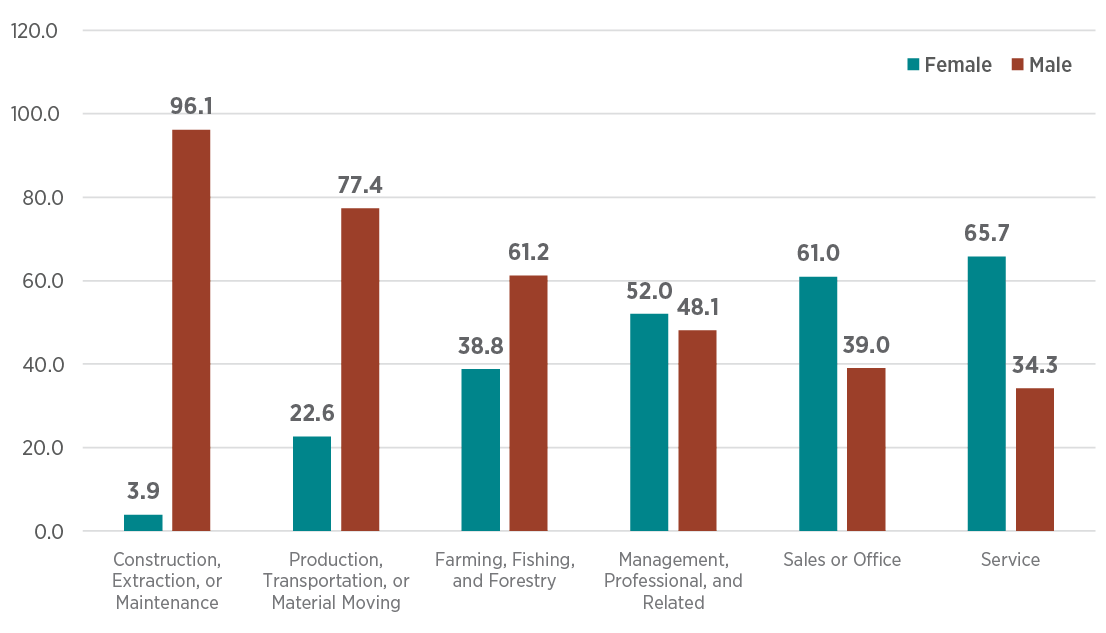
Table 4 and Figure 2 show significant gender differences across occupational groups. Women make up 47.9% of the workforce overall but are highly concentrated in service (65.7%) and sales or office occupations (61%). Women also slightly outnumber men in management, professional, and related occupations (52%).
Men overwhelmingly dominate construction, extraction, and maintenance occupations (96.1%) and production, transportation, and material-moving work (77.4%). They also make up a
majority in farming, fishing, and forestry (61.2%). These results illustrate persistent occupational gender segregation.
Table 4. Selected Occupation by Gender in Michigan, 2020–2024
|
Selected occupation |
Female |
Male |
|---|---|---|
|
Total |
47.9 |
52.1 |
|
Construction, extraction, or maintenance |
3.9 |
96.1 |
|
Production, transportation, or material moving |
22.6 |
77.4 |
|
Farming, fishing, and forestry |
38.8 |
61.2 |
|
Management, professional, and related |
52.0 |
48.1 |
|
Sales or office |
61.0 |
39.0 |
|
Service |
65.7 |
34.3 |
Source: U.S. Census Bureau, Current Population Survey, 2020 -2024 Annual Social and Economic Supplement (CPS ASEC).
Figure 2. Selected Occupation by Gender in Michigan, 2020–2024
Source: U.S. Census Bureau, Current Population Survey, 2020 -2024 Annual Social and Economic Supplement (CPS ASEC).
OCCUPATIONS BY RACE/ETHNICITY AND GENDER, 2020-2024
Occupational patterns vary significantly by both race/ethnicity and gender. White and Asian workers are more likely to be employed in management and professional occupations, while African American and Latino/Hispanic workers are more likely to work in service, production, and transportation roles.
Notably:
-
Asian men: 59.2% work in management and professional occupations.
-
African American men: Only 24.6% work in these occupations, with 37.7% concentrated in production and transportation.
-
White women: More likely to work in professional roles (48.1%) than white men (41.5%).
-
Latino men: Highly concentrated in production (33.4%) and construction (10.6%).
-
Latina women: More represented in management/ professional and service jobs than Latino men.
These disparities show that occupational segregation is shaped by the interaction of race/ethnicity and gender.
Table 5. Selected Occupation by Race/Ethnicity and Gender in Michigan, 2020–2024
|
Race/ethnicity/gender |
Management, professional, and related |
Service |
Sales or office |
Construction, extraction, or maintenance |
Production, transportation, or material moving |
Farming, fishing, and forestry |
|
|---|---|---|---|---|---|---|---|
|
White |
All |
44.7 |
14.0 |
19.7 |
7.4 |
13.7 |
0.5 |
|
Female |
48.1 |
19.1 |
25.9 |
0.4 |
6 |
0.5 |
|
|
Male |
41.5 |
9.4 |
14.2 |
13.6 |
20.6 |
0.6 |
|
|
Latino/ Hispanic |
All |
34.8 |
17.5 |
13.9 |
5.9 |
25.7 |
2.2 |
|
Female |
42.7 |
20.6 |
18.9 |
0.0 |
16.1 |
1.8 |
|
|
Male |
28.4 |
15.1 |
10 |
10.6 |
33.4 |
2.5 |
|
|
Asian |
All |
58.9 |
13.2 |
11.1 |
3.2 |
13.6 |
0.0 |
|
Female |
58.5 |
22.1 |
10.2 |
2.6 |
6.5 |
0.0 |
|
|
Male |
59.2 |
5.8 |
11.8 |
3.6 |
19.5 |
0.0 |
|
|
African American |
All |
30.2 |
18.6 |
22.8 |
3.5 |
24.6 |
0.3 |
|
Female |
35.1 |
26.5 |
24.5 |
0.8 |
13.1 |
0.0 |
|
|
Male |
24.6 |
9.5 |
20.9 |
6.7 |
37.7 |
0.6 |
|
Source: U.S. Census Bureau, Current Population Survey, 2020 -2024 Annual Social and Economic Supplement (CPS ASEC).
INDUSTRY DISTRIBUTION IN MICHIGAN, 2020–2024
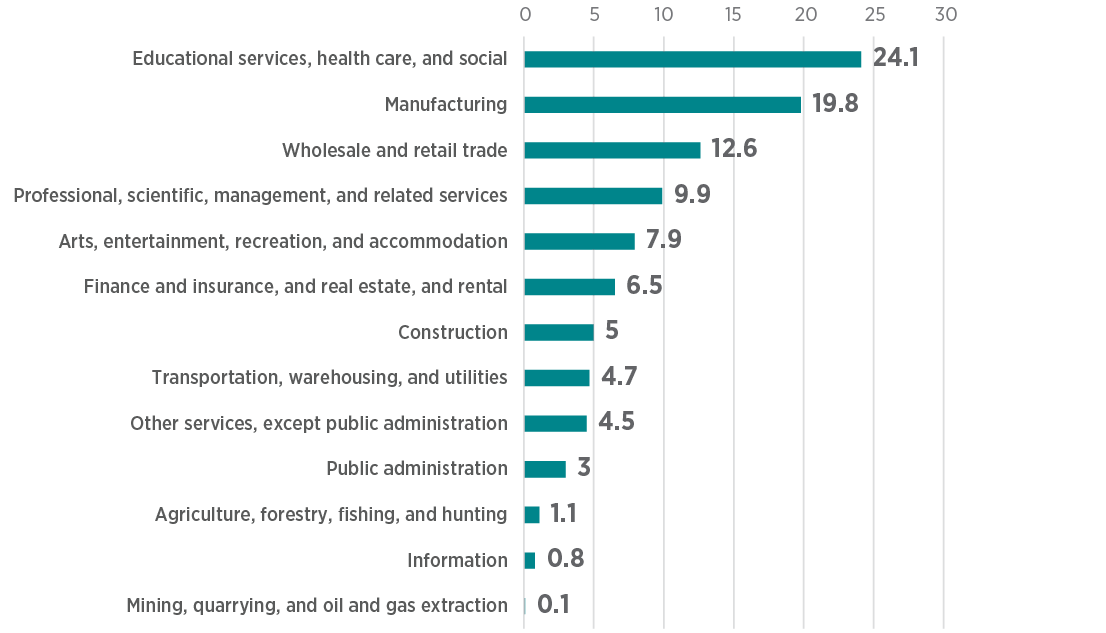
Table 6 and Figure 3 show that the largest share of Michigan’s workforce is employed in educational services, health care, and social assistance (24.1%), followed by manufacturing (19.8%) and wholesale and retail trade (12.6%). Smaller industries such as agriculture (1.1%) and mining (0.1%) make up only a small portion of employment.
These findings underscore the importance of health care, education, and manufacturing in the state’s economy.
Table 6. Industries Distribution in Michigan, 2020–2024
|
Industry |
Total population |
Percentage of total population |
|---|---|---|
|
Total |
47.9 |
52.1 |
|
Educational services, health care, and social |
1,089,346 |
24.1 |
|
Manufacturing |
895,721 |
19.8 |
|
Wholesale and retail trade |
568,925 |
12.6 |
|
Professional, scientiic, management, and related services |
446,083 |
9.9 |
|
Arts, entertainment, recreation, and accommodation |
355,365 |
7.9 |
|
Finance and insurance, and real estate and rental |
295,280 |
6.5 |
|
Construction |
225,633 |
5 |
|
Transportation, warehousing, and utilities |
213,116 |
4.7 |
|
Other services, except public administration |
202,509 |
4.5 |
|
Public administration |
138,017 |
3 |
|
Agriculture, forestry, fishing, and hunting |
52,008 |
1.1 |
|
Information |
38,446 |
0.8 |
|
Mining, quarrying, and oil and gas extraction |
6,349 |
0.1 |
Source: U.S. Census Bureau, Current Population Survey, 2020 -2024 Annual Social and Economic Supplement (CPS ASEC).
Figure 3. Industries Distribution in Michigan, 2020–2024
Source: U.S. Census Bureau, Current Population Survey, 2020 -2024 Annual Social and Economic Supplement (CPS ASEC).
INDUSTRY BY RACE/ETHNICITY IN MICHIGAN, 2020–2024
Employment is unevenly distributed across industries by race and ethnicity:
- Latino workers are concentrated in manufacturing (25.8%) and accommodation/entertainment (13.4%).
- African American workers are heavily employed in health care and social assistance (28.6%) and transportation (10.6%).
- Asian workers are most concentrated in manufacturing (30.2%) and in educational and health services (22.3%).
- White workers show broader distribution across industries, including agriculture and construction.
Table 7. Industries by Race/Ethnicity in Michigan, 2020–2024
|
Industry |
White only |
African American only |
Latino/ Hispanic |
Asian only |
|---|---|---|---|---|
|
Agriculture, forestry, fishing, and hunting |
1.24 |
0.27 |
3.18 |
0.0 |
|
Arts, entertainment, recreation, and accommodation |
7.71 |
5.24 |
13.42 |
8.44 |
|
Construction |
5.84 |
1.81 |
3.82 |
0 |
|
Educational services, health care, and social |
23.86 |
28.62 |
15.9 |
22.33 |
|
Finance and insurance, and real estate and rental |
6.42 |
6.26 |
8.76 |
7.83 |
|
Information |
1.04 |
0.31 |
0.0 |
0.0 |
|
Manufacturing |
18.88 |
20.42 |
25.8 |
30.17 |
|
Mining, quarrying, and oil and gas extraction |
0.14 |
0.28 |
0.0 |
0.0 |
|
Other services, except public administration |
4.56 |
2.48 |
3.99 |
8.72 |
|
Professional, scientific, management, and related services |
10.44 |
7.68 |
8.02 |
7.77 |
|
Public administration |
2.89 |
4.3 |
3.7 |
1.29 |
|
Transportation, warehousing, and utilities |
3.83 |
10.62 |
5.24 |
5.06 |
|
Wholesale and retail trade |
13.14 |
11.71 |
8.15 |
8.39 |
Source: U.S. Census Bureau, Current Population Survey, 2020 -2024 Annual Social and Economic Supplement (CPS ASEC).
INDUSTRY BY GENDER IN MICHIGAN, 2020–2024
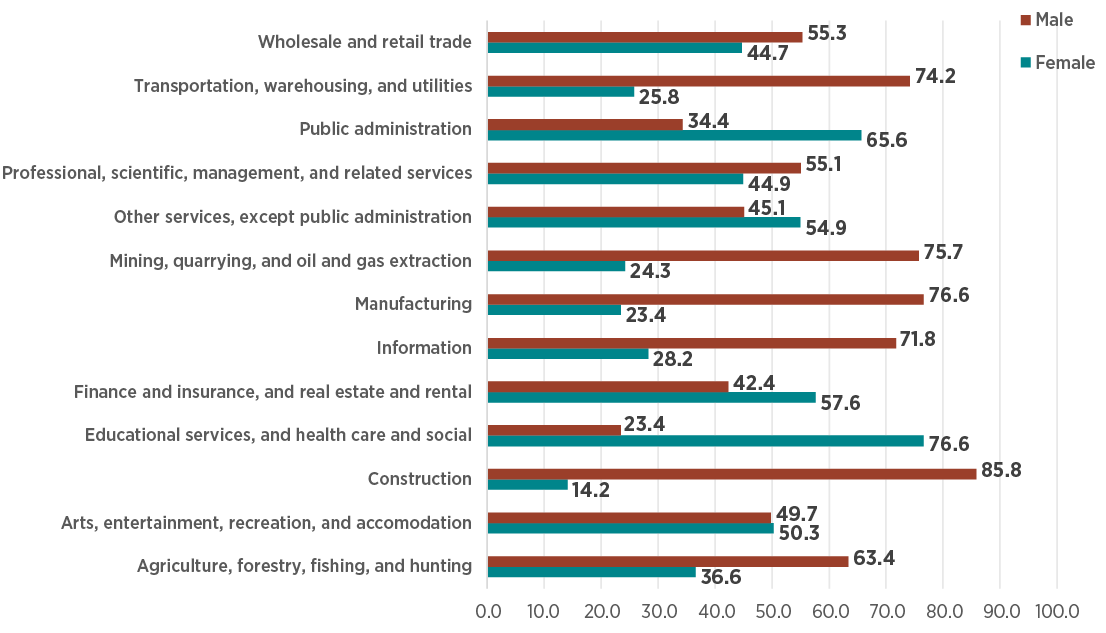
Table 8 and Figure 4 show clear gender disparities in industry-level employment.
Women are the majority in:
- Education, health care, and social assistance (76.6%)
- Public administration (65.6%)
- Finance and insurance (57.6%)
- Other services (54.9%)
Men dominate:
- Construction (85.8%)
- Mining (75.7%)
- Transportation and utilities (74.2%)
- Manufacturing (76.6%)
These trends reflect longstanding gender segmentation across industries.
Table 8. Industries by Gender in Michigan, 2020–2024
|
Industry |
Female |
Male |
|---|---|---|
|
Total |
47.9 |
52.1 |
|
Agriculture, forestry, fishing, and hunting |
36.6 |
63.4 |
|
Arts, entertainment, recreation, and accommodation |
50.3 |
49.7 |
|
Construction |
14.2 |
85.8 |
|
Educational services, health care, and social |
76.6 |
23.4 |
|
Finance and insurance, and real estate and rental |
57.6 |
42.4 |
|
Information |
28.2 |
71.8 |
|
Manufacturing |
23.4 |
76.6 |
|
Mining, quarrying, and oil and gas extraction |
24.3 |
75.7 |
|
Other services, except public administration |
54.9 |
45.1 |
|
Professional, scientific, management and related services |
44.9 |
55.1 |
|
Public administration |
65.6 |
34.4 |
|
Transportation, warehousing, and utilities |
25.8 |
74.2 |
|
Wholesale and retail trade |
44.7 |
55.3 |
Source: U.S. Census Bureau, Current Population Survey, 2020 -2024 Annual Social and Economic Supplement (CPS ASEC).
Figure 4. Industries by Gender in Michigan, 2020–2024
Source: U.S. Census Bureau, Current Population Survey, 2020 -2024 Annual Social and Economic Supplement (CPS ASEC).
CONCLUSION
The findings of this study show clear racial/ethnic and gender disparities in Michigan’s labor force between 2020 and 2024. White and Asian workers are disproportionately represented in higher-status occupations, while African American and Latino workers remain concentrated in service, production, and transportation roles. Women are highly represented in service and health-related fields, whereas men dominate construction, production, and industrial work.
These patterns reveal that labor force opportunities remain unevenly distributed. Despite gains in employment for some groups, structural inequalities in occupational and industry representation persist.
Addressing these disparities will require targeted policy interventions, workplace reforms, and expanded access to high-quality education and training opportunities.